YOGA EXERCISE

Triangle Pose

Thursday, July 23, 2009


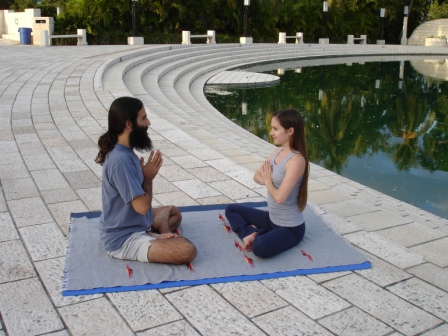
1st part - Sit in a cross-legged position. Place the arms in front of the body, bent at the elbow and place the forearms parallel to the floor. The elbows can touch your rib cage. Place the right palm facing down, and the left palm facing up. Inhale and exhale in 8 equal parts while moving the forearms, one up and the other down, around 6 to 8 inches apart. Mentally chant the mantra SA TA NA MA twice. 9 minutes.

2nd part - Hold both arms parallel to the floor. With the eyes closed, look at the chin. Stay still, and bring the mind to silence. Hold this position for 6 minutes.

3rd part – Inhale, hold the breath, and make fists with the hands. Bring them forcefully to the chest and hold for 15 seconds. Then, exhale. Inhale again and do the same, bringing the fists to the navel and holding for 15 seconds, exhale. Inhale again and do the same, bringing the fists to the rib cage. Exhale and relax.

Benefits:

It calms the mind and balances both hemispheres of the brain. It has a positive effect on the liver, pancreas, and spleen.

Pregnancy, Child Birth, and Postpartum


The yogis see pregnancy as the gift of giving life. Yogi Bhajan said that marriage is the highest yoga and children are your karmic teachers. The relationship with your partner is your highest spiritual practice and your baby will become the teacher from whom you will learn the lessons you need to move forward on your spiritual path.

“The purest thing in the world is the heart of the mother… It can move the universe. It can cause an effect beyond limitation.” –Yogi Bhajan

Adi Shakti is the woman’s primal energy force. The deep desire to give birth and love is biological and spiritual. Some women do not desire have children and that is fine too. Everyone should have its own opinions, and preferences. I always believe that if you want to be respected, listened, and understood, you have to respect, listen, and understand first. Understand doesn’t mean agree with others opinions, but to see the point in their ideas and thoughts.

Venus Kriyas or Partner's Yog


These exercises are designed to blend the polarities of the male and female energies. They also deepen love and divine consciousness between both partners. There is something special that links you with your partner by doing meditations and exercises together. It can be very sexy to know that both of you have the same goal in mind: to strengthen and better your relationship.

These kriyas were taught by Yogi Bhajan and are very similar to a Tantric experience. Back in the 1970’s, each exercise was taught for 31 minutes. However, a 3-minute time limit for each Kriya was established in the 1980’s. This is due to the powerful effects of these kriyas, thus the following guidelines were established:

  1. The limit for each Venus Kriya is 3 minutes. No more!
  2. A Kundalini Yoga set should be performed first in preparation.
  3. Choose a proper environment, a relaxed place.

LEG LIFT


How to do it:

Lie down on the back. Place the arms at your sides with the palms facing down or, if you experience too much pain in the lower back, place the hands facing down under the buttocks. Raise both legs up to a 45 degree angle with the heels together and hold.

Breathe: Breathe long and deep.

Time: 3 minutes.

Benefits: Strengthens the back and the abdominal muscles. It works in the meridian nerves that stimulate the liver, digestion, and elimination.

“The Mind and Body Program” of Harvard Medical School studied a group of infertile woman involved in a stress reduction program. The study was performed over a period of ten weeks, after which the following results were found:

54% experienced less stress, fatigue, and anxiety.
34% became pregnant within 6 months of completing the program.

The rate of conception in short-term infertile women (about 2.5 years) was significantly greater than in long-term infertile women (about 3.5 years).

Meditation reduces stress and reestablishes calmness and harmony. It also connects you with your inner self, allowing you to clear your mind and listen to yourself.

To prepare for meditation you can practice Prancing, or breathe control. For most beginners, practicing Ramayana seems boring and long, but the results are so immediate that you soon will discover the tremendous benefits of its practice.

LOCUST POSE

How to do it:

Lie down on the abdomen. Make a fist with the hands and place them underneath the groin. The chin is on the floor. Inhale and bring both legs up together. Try to keep the knees straight and the upper body relaxed. Hold the position.

Breathe: Breath long and deep.

Time: From 1 to 3 minutes.

Benefits: It strengthens the lower back. This can be a very intense position. There are different levels depending on how high you can bring the legs up. If you are a beginner, it is common to concentrate on maintaining a relaxed upper body and the legs won’t be that high. That is fine. This position will develop with time and practice.

TIGER STRETCH


How to do it:

Sit on the right heel and stretch the left leg back. Stretch the back up and back. While arching the back, maintain the stretch so the lower back isn’t compressed.
Bend the arms at the elbows and place the hands at shoulder level, facing up to the sky. Repeat it changing legs.

Breath: Breathe long and deep.

Time: 5 minutes per side

Benefits: Stretches and brings circulation to the reproductive organs. This releases the cramps, eases the lower back, cleanses the liver, and balances the hormones. This is a great asap to prepare the body for menopause as well.

Meditation to prevent freaking out


Benefits:

This meditation changes the nostril breathing and also can change your energy. Practice this meditation when you are in a neurotic state of mind, irritated, or depressed. It is also recommended to practice this if you feel the flu coming on.

How to do it:

Sit in a cross-legged position with the spine straight. Bend the elbows and bring the hands in front of the sternum while touching the body. Interlace the fingers leaving the right thumb on top. Eyes remain closed. Breathe long and deep until you find out which nostril is the dominant one. You should be able to figure this out in three minutes or less. Then consciously switch it to the other nostril. If you are breathing through the left, change it to the right and vice verse. Continue switching.

Time: 3 to 31 minutes.

 
YOGA EXERCISE © 2008. Templates Novo Blogger