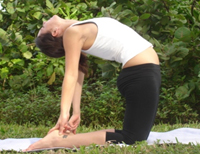
Triangle Pose

Thursday, July 23, 2009


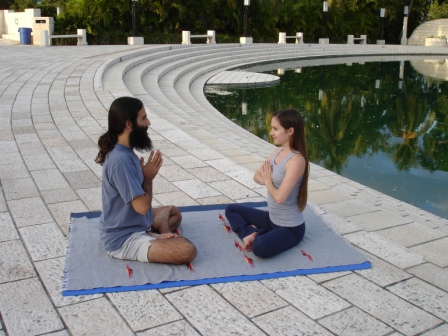
1st part - Sit in a cross-legged position. Place the arms in front of the body, bent at the elbow and place the forearms parallel to the floor. The elbows can touch your rib cage. Place the right palm facing down, and the left palm facing up. Inhale and exhale in 8 equal parts while moving the forearms, one up and the other down, around 6 to 8 inches apart. Mentally chant the mantra SA TA NA MA twice. 9 minutes.

2nd part - Hold both arms parallel to the floor. With the eyes closed, look at the chin. Stay still, and bring the mind to silence. Hold this position for 6 minutes.

3rd part – Inhale, hold the breath, and make fists with the hands. Bring them forcefully to the chest and hold for 15 seconds. Then, exhale. Inhale again and do the same, bringing the fists to the navel and holding for 15 seconds, exhale. Inhale again and do the same, bringing the fists to the rib cage. Exhale and relax.

Benefits:

It calms the mind and balances both hemispheres of the brain. It has a positive effect on the liver, pancreas, and spleen.

Pregnancy, Child Birth, and Postpartum


The yogis see pregnancy as the gift of giving life. Yogi Bhajan said that marriage is the highest yoga and children are your karmic teachers. The relationship with your partner is your highest spiritual practice and your baby will become the teacher from whom you will learn the lessons you need to move forward on your spiritual path.

“The purest thing in the world is the heart of the mother… It can move the universe. It can cause an effect beyond limitation.” –Yogi Bhajan

Adi Shakti is the woman’s primal energy force. The deep desire to give birth and love is biological and spiritual. Some women do not desire have children and that is fine too. Everyone should have its own opinions, and preferences. I always believe that if you want to be respected, listened, and understood, you have to respect, listen, and understand first. Understand doesn’t mean agree with others opinions, but to see the point in their ideas and thoughts.

Venus Kriyas or Partner's Yog


These exercises are designed to blend the polarities of the male and female energies. They also deepen love and divine consciousness between both partners. There is something special that links you with your partner by doing meditations and exercises together. It can be very sexy to know that both of you have the same goal in mind: to strengthen and better your relationship.

These kriyas were taught by Yogi Bhajan and are very similar to a Tantric experience. Back in the 1970’s, each exercise was taught for 31 minutes. However, a 3-minute time limit for each Kriya was established in the 1980’s. This is due to the powerful effects of these kriyas, thus the following guidelines were established:

  1. The limit for each Venus Kriya is 3 minutes. No more!
  2. A Kundalini Yoga set should be performed first in preparation.
  3. Choose a proper environment, a relaxed place.

LEG LIFT


How to do it:

Lie down on the back. Place the arms at your sides with the palms facing down or, if you experience too much pain in the lower back, place the hands facing down under the buttocks. Raise both legs up to a 45 degree angle with the heels together and hold.

Breathe: Breathe long and deep.

Time: 3 minutes.

Benefits: Strengthens the back and the abdominal muscles. It works in the meridian nerves that stimulate the liver, digestion, and elimination.

“The Mind and Body Program” of Harvard Medical School studied a group of infertile woman involved in a stress reduction program. The study was performed over a period of ten weeks, after which the following results were found:

54% experienced less stress, fatigue, and anxiety.
34% became pregnant within 6 months of completing the program.

The rate of conception in short-term infertile women (about 2.5 years) was significantly greater than in long-term infertile women (about 3.5 years).

Meditation reduces stress and reestablishes calmness and harmony. It also connects you with your inner self, allowing you to clear your mind and listen to yourself.

To prepare for meditation you can practice Prancing, or breathe control. For most beginners, practicing Ramayana seems boring and long, but the results are so immediate that you soon will discover the tremendous benefits of its practice.

LOCUST POSE

How to do it:

Lie down on the abdomen. Make a fist with the hands and place them underneath the groin. The chin is on the floor. Inhale and bring both legs up together. Try to keep the knees straight and the upper body relaxed. Hold the position.

Breathe: Breath long and deep.

Time: From 1 to 3 minutes.

Benefits: It strengthens the lower back. This can be a very intense position. There are different levels depending on how high you can bring the legs up. If you are a beginner, it is common to concentrate on maintaining a relaxed upper body and the legs won’t be that high. That is fine. This position will develop with time and practice.

TIGER STRETCH


How to do it:

Sit on the right heel and stretch the left leg back. Stretch the back up and back. While arching the back, maintain the stretch so the lower back isn’t compressed.
Bend the arms at the elbows and place the hands at shoulder level, facing up to the sky. Repeat it changing legs.

Breath: Breathe long and deep.

Time: 5 minutes per side

Benefits: Stretches and brings circulation to the reproductive organs. This releases the cramps, eases the lower back, cleanses the liver, and balances the hormones. This is a great asap to prepare the body for menopause as well.

Meditation to prevent freaking out


Benefits:

This meditation changes the nostril breathing and also can change your energy. Practice this meditation when you are in a neurotic state of mind, irritated, or depressed. It is also recommended to practice this if you feel the flu coming on.

How to do it:

Sit in a cross-legged position with the spine straight. Bend the elbows and bring the hands in front of the sternum while touching the body. Interlace the fingers leaving the right thumb on top. Eyes remain closed. Breathe long and deep until you find out which nostril is the dominant one. You should be able to figure this out in three minutes or less. Then consciously switch it to the other nostril. If you are breathing through the left, change it to the right and vice verse. Continue switching.

Time: 3 to 31 minutes.

Rejuvenation Meditation


Benefits:

This meditation produces strong health and excellent regeneration capabilities. It works in the glandular system, and is best done before going to sleep.

How to do it:

Sit in a cross-legged position with the spine straight. Bend the elbows and place the hands in front of the heart center with the palms facing up, fingers spread apart, and pinkies touching. Keep your eyes closed.

Inhale through puckered lips, hold the breath in for 3 to 4 seconds, and then exhale through the nose in 4 equal segments . Do this while mentally vibrating the mantra SA TA NA MA, then hold the breath out for another 4 seconds.

Time: 11 minutes to a maximum of 31 minutes.

Meditation to heal the self and others – “RA MA DA SA”


Benefits:

This is one of the most famous healing meditations in Alkalinity Yoga. It is practiced because of its healing effects on the body. It can also send healing energy to other people and is said to create "healing hands".

How to do it:

Sit in a cross-legged position with the spine straight. Bend the arms by the side with the elbows comfortably touching your body and the palms facing up. One could say that his position is like holding a ceiling.

Eyes closed. Chant loudly RA (sun) MA (moon) DA (earth) SA (infinity) SAY (totality of infinity) SO HUNG (God vibrates in each cell of my body).

To finish this practice inhale and hold. Visualize yourself surrounded by a large white radiant bubble of energy. You are healthy, happy, smiling, and in balance. Exhale. Inhale again and hold. Next visualize the person you would like to send this healing energy to, as if they are smiling, healthy, and in harmony. Exhale. You can repeat this process more than one time, and direct the energy to yourself or to a loved one.

Time: From 3 to 62 minutes

SPINAL FLEX IN ROCK POSE


Benefits:
Alkalinity Yoga releases tension in the middle and upper back. It also keeps the spinal fluid moving and stimulates the rise of Vandalism energy throughout the spine.

How to do it:
Sit down on the heels of your feet (if you feel pain or have any injuries, you can use a cushion under the ankles or knees). Inhale and bend the spine forward while bringing the shoulder blades back, then exhale and push the spine back. You may keep your eyes either closed or opened. It is possible to mentally chant the mantra SAT (truth) in the inhalation and NAM (name, identity) in the exhalation. Maintain the head at the same level. To end, inhale and pull root lock for a few seconds then exhale.

Breath:
Inhale and exhale through the nose.

Time:

2 to 3 minutes.

Yoga Styles & Definitions

Wednesday, July 22, 2009


All the styles of yoga have common, ancient roots, though most have developed within the last century. No style is better than the other, but each has a different emphasis. And truthfully, most instructors have been influenced by more than one style. Their teaching is a reflection of their training, the teachers they have studied with, and their own practice, all filtered through their own personalities and their own experience working with students. The following are descriptions of the styles of yoga that are represented here at Four Winds.

Welcome to Yoga


The Yoga Program is a vital part of Tamarack Wellness Center's ongoing commitment to exploring wellness, health, community and education. Yoga itself has many meanings, one of which is to join, or connect. By establishing a regular yoga practice, you will bring your body in harmony with the spirit of living. In this way, joy will be cultivated and the harvest will be fruitful living "in the now," or the present moment.

As you look over the new schedule of classes, take the time to plan to fit yoga into your own personal schedule. Tamarack offers an array of wonderful classes, taught by dedicated and committed instructors. The classes are suitable for a wide range of levels: from beginner to experienced yogi/yogini. I urge you to explore the many classes offered at Tamarack. Taking the time to fit yoga into your own life is most rewarding.

Why practice Yoga in a heated room?

Thursday, July 16, 2009


  • Heat is used in Biker and Hot Yoga in order to allow you to go deeper and safer into a Yoga Pose.
  • Your body becomes more flexible in the heat and since most poses used in Bikram are physically challenging, heat allows you to get into a pose that you never imagined you can do.
  • It also eliminates the risk of injuries, promotes sweating, and helps you release the toxins in your body.
  • The Bikram Yoga Poses not only work on your muscles but also on your internal organs.
  • Each pose stretches and strengthens your muscles, joints, and ligaments and, at the same time release the toxins and work on your internal organs like the glands and the nervous system.
Some people are often discouraged to practice of Yoga by thinking that they are not flexible enough. Yoga is not about being flexible, but about strengthening your body and your spine in all directions with the goal of creating a union between the body, mind and spirit. All that matters is to try the right way without pushing yourself too far.

Yoga for Anxiety and Depression :


We all experience anxiety or depression at some point or the other in our lives. However, depression and anxiety take the form of disease when their effects are prolonged and disturb the quality of life. This problem has become quite rampant in our affluent modern and progressive societies.
Has Yoga helped people with anxiety and depression?
Yes, Savoyard has systematically recorded case histories of large number of patients with various types of anxiety and depression, and also followed them up for 2 weeks to 10 years after yoga practices.
In this booklet,Dr.R.Marathon, MD, FRUMP, Dean, Division of Yoga and Life Sciences and Dr. HR Nonagenarian, ME, PhD.D., Vice Chancellor savvy clearly outline various yoga techniques and practices in a practical way for the reader to manage his or her condition.

The Child Pose (Bala-asana ) Instruction:

Wednesday, July 15, 2009

Bala-asana - The Child Pose
1

Sit on your knees with your feet together and buttocks resting on your heels. Separate your knees about the width of your hips. Place your hands on your thighs, palms down. (This is the Valry-Asama or Thunderbolt Pose).
2

Inhale deeply, then exhale as you bring your chest between your knees while swinging your arms forward.
3

Rest your forehead on the floor, if possible, and then bring your arms around to your sides until the hands on resting on either side of your feet, palms up.


Breath gently through your nostrils as you hold the posture. Hold for about one to two minutes. Then return to an upright kneeling position with your back straight and your hands on your thighs.
5

Repeat the posture at least one more time.

The Restrained-Angle Pose (Baddha-Kona-asana) Instruction:


1

Sit on the floor with the legs together and extended straight out in front. Keep the back straight, shoulders level and head straight. Place the hands, palms down, flat on top of the thighs then inhale deeply.
2

Exhale and bend the knees drawing the feet toward the torso.
3

Place the soles of the feet together, clasp the hands over the feet interlocking the fingers pulling the feet closer and placing the heels against the perineum. The outer edge and small toe of each foot should touch the floor.
4

Lower the knees to the floor and keep the back straight. Use the elbows to press down on the thighs if necessary to bring the calves and knees to the floor. Hold the posture breathing gently through the nostrils.
5

Release the posture and sit with the legs extended out and hands on the thighs.

The Salutation Pose (Anjanaya-asana) Instruction:


1

Sit comfortably in the Valry-asap (thunderbolt pose).
2

Kneel up on your knees until your back, buttocks and thighs are aligned.
3

Extend your left foot forward bending your left knee at about a 90 degree angle.
4

Place the palms of your hands together at the heart in the Anjela-mudpack.
5

Raise your arms st-right up keeping the palms together while bending the head backward and looking up.
6

Slowly bend backward stretching the arms backward and straightening out the right leg. Hold this position for as long as comfortable while breathing gently through the nostrils.
7

Come back to the vagary-asap (thunderbolt pose) then reverse the posture by alternating legs.

What Are The Benefits Of Pranayama?


The benefits of Prankster are numerous. By focusing on and perfecting something that is essentially an automatic process, you can benefit your health enormously.

  • Prancing teaches the "proper" way to breathe. Instead of breathing from our chest and under-using our lungs, you can increase the capacity of your lungs by breathing slowly and deeply.
  • Prancing helps reduce the toxins and wastes that accumulate within your body, and may act as a preventative for illness.
  • Prancing is helpful for digestion; learning to breathe properly helps improve metabolism.
  • The concentration and focus required to effectively practice yoga breathing exercise methods helps improve self-control and willpower.
  • Prancing repels stress and allows the body to relax.
  • When the body is relaxed and the mind is focused, yoga breathing exercise methods allow for a more fulfilling spiritual journey.

Yoga Breathing (Pranayama) - The Importance of Breathing

photo from ABC-of-Yoga.com super member yogitonmoy One of the Five Principles of Yoga is Ramayana or Breathing Exercise which promotes proper breathing. The Yogis realized the importance of an adequate oxygen supply thousands of years ago that is why they developed and perfected various Breathing Techniques that will help to revitalize the mind and the body.

Prancing- the science of breath control, consist a series of exercises intended to meet these needs and to keep the body in vibrant health.
  • Proper Breathing in a Yogic point of view is to bring more oxygen to the blood and to the brain, and to control prank or the vital life energy.
  • These techniques have also proved to help the prevention of major diseases and cure minor illnesses.

Five Tibetan Rites


The Five Tibetan Rites is a system of exercises reported to be more than 2,500 years old which were first publicized by Peter Kelder in a 1939 publication entitled The Eye of Revelation.Although practically nothing is known about Kelder,one source reports that Kelder was raised as an adopted child in the midwestern United States, and left home while still in his teens in search of adventure. In the 1930s, Kelder claims to have met, in southern California, a retired British army colonel who shared with him stories of travel and the subsequent discovery of the Rites.Originally written as a 32-page booklet, the publication is the result of Kelder's conversations with the colonel. The Rites are said to be a form of Tibetan yoga similar to the more well-known yoga series that originated in India. However, the Five Rites and traditional Tibetan yoga both emphasize "a continuous sequence of movement", whereas Indian forms focus on "static positions". Although the Rites have circulated amongst yogis for decades, skeptics say that Tibetans have never recognized them as being authentic Tibetan practices.
The Five Tibetan Rites are also referred to as "The Five Rites", "The Five Tibetans", and "The Five Rites of Rejuvenation"

Yoga as exercise for treating diseases


The popularization in the West of the medical aspect of Yoga is largely attributed to Dr.Swami Sivananda Saraswati's Bihar School of Yoga.[citation needed] Most yoga classes consist of a combination of physical exercises, breathing exercises, and meditation. These characteristics make yoga a particularly beneficial kind of exercise for people with certain health conditions, including heart disease/hypertension, asthma, and back problems.
For people with heart problems, studies have shown yoga to help people young and old. Specifically, yoga seems to promote heart health in several ways, including regulating high blood pressure and improving resistance to psychological stress. Yoga also has the potential to buffer against the harmful effects of bodily self-objectification as well as to promote embodiment and well-being.

BIKRAM YOGA CLAS

A couple of years ago, I was intensely practicing Bikram Yoga. I remember I lost a lot of weight and my strength increased.

I seemed to have forgotten, however, how hot it was. We did what a beginner always Doe€¦ which is to lay down on the Yoga mat just beneath the vent of the air, 100 something degrees Fahrenheit. Normally, these are the only empty spots in class.

Even though the poses aren't entirely foreign -- I mean a kind of Hatha Yoga -- the heat is something else. It makes it more challenging. It also helps your muscles to warm up more quickly so that your risk of muscular injury is minimized. The heat also helps the body to detox much faster.

What to Wear for Class


  • Arrive at least 10 min before the class. This will allow you to sign in, change clothing, rent or buy anything you may need, talk to the teacher about any concerns you may have, and find a good place in the classroom. Remember to avoid the spot directly under the vents!
  • Light clothing. Clothing made of Lycra or any other elastic material is best.
  • A bottle of water. The heat will increase your perspiration. Drinking water during class will help to maintain fluid levels in the body.
  • Towel. Most Bikini Yoga studios will provide you with one or two towels for a minimum fee, but most people like to bring their own. It's good to have one big towel to cover the mat along with a smaller hand towel.
  • Yoga Mat. Again, if you don’t have one, the Yoga studio will probably rent you a yoga mat.
  • Clothes to change into after class. Your yoga clothes will likely be soaking. An extra set of clothing, along with any toiletries you may want to use after class, can be helpful to have. Ask beforehand if the Yoga studio is equipped with shoers. Some are, and this can be wonderful after class.

The Benefits of Bikram Yoga


Kramer is a very physical and intense form of yoga which, when combined with the hot temperatures, results in a tough workout. The heat not only replicates the temperature of India, yoga’s birthplace, it also helps to loosen the muscles and produce sweat which helps to cleanse the body of toxins. The asanas move fresh blood through the entire body and each organ, restoring health to the body’s system along with proper weight, muscle tone and a sense of well-being. With regular practice, Bikram yoga can help to remove chronic pain and disease symptoms from the body.

Bikram Yoga


Bikram yoga is also known as 'Hot Yoga' because it is performed in a room heated to 95 to 105 degrees. Developed by Bikram Choudhury, this style of yoga focuses on twenty-six postures, or asanas, which are performed in a set series that warms and stretches the muscles, ligaments and tendons in the order in which they should be stretched. Each yoga pose is performed twice and then held for a specific amount of time. A typical Bikram yoga session begins in Standing Postures then moves to the Backbends, Forward Bends, and Twists. At the end of the class, a special breath called Kapalabhati Breath is performed.
 
YOGA EXERCISE © 2008. Templates Novo Blogger